The way people exercise is changing. In 2026, the modern gym is no longer just a room filled with treadmills, benches, and dumbbells. Fitness has become more connected, personalized, social, and focused on long-term health.
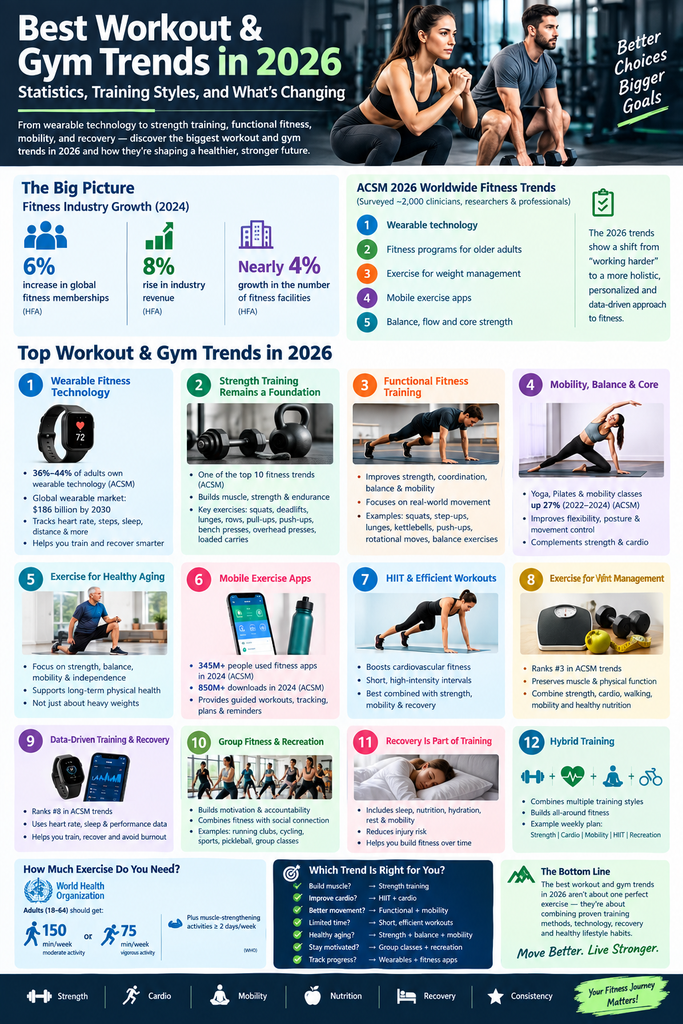
Wearable technology, mobile workout apps, strength training, functional fitness, mobility work, recovery, and exercise for healthy aging are all influencing how people train. At the same time, the commercial fitness industry continues to expand according to the Health & Fitness Association (HFA), global fitness memberships increased 6% year over year in 2025, while industry revenue increased an average of 8% and the number of facilities grew by nearly 4%.
So, what are the best workout and gym trends in 2026, and which training styles are actually worth paying attention to?
Let’s take a closer look.
Fitness Trends in 2026: The Big Picture
The American College of Sports Medicine (ACSM) released its 2026 Worldwide Fitness Trends after surveying about 2,000 clinicians, researchers, and exercise professionals. Wearable technology took the No. 1 position, followed by fitness programs for older adults, exercise for weight management, mobile exercise apps, and balance, flow, and core strength.
The 2026 trends show a noticeable shift away from the idea that fitness is simply about working harder.
Instead, the industry is moving toward:
- More personalized workouts
- Data-driven training
- Strength and functional movement
- Mobility and balance
- Mental well-being
- Healthy aging
- Flexible digital workouts
- Social and recreational fitness
- Sustainable exercise habits
In other words, fitness in 2026 is becoming more holistic.
1. Wearable Fitness Technology
Wearable technology is the biggest fitness trend of 2026 according to ACSM.
Fitness trackers, smartwatches, heart-rate monitors, and GPS devices are increasingly being used to monitor exercise and everyday health metrics. Depending on the device, users can track heart rate, steps, distance, sleep, training intensity, and other measurements.
ACSM estimates that roughly 36%–44% of adults own wearable technology, while the global wearable market is projected to reach $186 billion by 2030.
The important change is that wearables are moving beyond simple step counting.
People are increasingly using their data to answer questions such as:
- How hard did I train?
- Am I recovering adequately?
- How much activity am I getting each week?
- How does my heart rate respond to exercise?
- Is my training becoming more consistent?
Technology can be useful, but numbers should support good training decisions rather than become the sole measure of fitness.
2. Strength Training Remains a Fitness Foundation
Despite all the new technology, traditional strength training remains highly relevant in 2026.
Barbells, dumbbells, kettlebells, resistance machines, and bodyweight exercises continue to form the foundation of many gym programs. ACSM placed traditional strength training among its top 10 fitness trends for 2026.
A good strength-training program can include movements such as:
- Squats
- Deadlifts
- Lunges
- Rows
- Pull-ups
- Push-ups
- Bench presses
- Overhead presses
- Loaded carries
The exact exercises are less important than having a sensible program, appropriate technique, progressive resistance, and enough recovery.
For someone trying to build muscle, strength, or general physical capacity, resistance training remains one of the most practical workout styles available.
3. Functional Fitness Training
Functional fitness is another major gym trend in 2026.
Rather than training only for appearance, functional workouts focus on movements that can improve strength, coordination, balance, mobility, power, and physical performance in everyday activities.
ACSM defines functional fitness training as a combination of strength, power, mobility, and endurance movements designed to improve real-world physical performance.
Examples include:
- Squats
- Step-ups
- Lunges
- Farmer’s carries
- Kettlebell exercises
- Push-ups
- Pull-ups
- Rotational movements
- Balance exercises
Functional fitness can be adapted for beginners, athletes, older adults, and general gym-goers.
4. Balance, Mobility, Pilates, and Core Training
One of the more interesting fitness trends in 2026 is the growing emphasis on balance, flow, mobility, and core strength.
ACSM ranks Balance, Flow, and Core Strength fifth in its 2026 trends. This category includes activities such as yoga, Pilates, barre, and mobility-focused training. Participation in yoga, Pilates, and mobility-focused classes increased 27% between 2022 and 2024, according to ACSM.
This trend reflects an important change in how people think about fitness.
A workout does not always have to be exhausting to be useful.
Mobility and core-focused sessions can complement strength and cardio training by developing movement control, coordination, and range of motion.
For many people, adding one or two mobility-focused sessions to a weekly routine can be more sustainable than constantly increasing workout intensity.
5. Exercise for Healthy Aging
Fitness programs designed for older adults are another major trend in 2026.
ACSM ranks Fitness Programs for Older Adults second in its annual list. The focus is on maintaining or improving muscle mass, strength, balance, mobility, and physical independence.
This is especially significant as populations age.
Training for healthy aging is not simply about lifting heavy weights. A well-rounded program can include:
- Resistance training
- Balance exercises
- Walking or other aerobic activity
- Mobility work
- Coordination exercises
- Functional movements
The goal is to maintain the physical abilities needed for everyday life.
6. Mobile Exercise Apps
Not everyone has time to spend an hour at a commercial gym.
That is one reason mobile exercise apps continue to be popular.
ACSM ranks Mobile Exercise Apps fourth among its 2026 fitness trends. In 2024, more than 345 million people used fitness apps, generating more than 850 million downloads.
Apps can provide:
- Guided workouts
- Exercise demonstrations
- Workout tracking
- Training plans
- Reminders
- Progress monitoring
- On-demand classes
For people with busy schedules, this flexibility can make exercise easier to fit into daily life.
However, an app is only as effective as the program and the consistency of the person using it.
7. HIIT and Efficient Workouts
High-intensity interval training, or HIIT, remains a popular training style for people who want challenging workouts in a relatively short period.
A typical HIIT session alternates higher-intensity work with recovery periods. It can be performed using running, cycling, rowing, bodyweight exercises, or other forms of cardio.
HIIT can be useful for improving cardiovascular fitness and adding variety to a training program. But more intensity is not automatically better.
A balanced fitness routine should also include easier sessions and recovery.
For many people, a combination of strength training, moderate aerobic activity, and occasional higher-intensity intervals is more practical than doing HIIT every day.
8. Exercise for Weight Management
Weight management is another prominent fitness focus in 2026.
ACSM ranks Exercise for Weight Management third in its 2026 Worldwide Fitness Trends. The organization notes that exercise can be particularly relevant for maintaining muscle and physical function as part of broader weight-management approaches.
A weight-management workout plan does not need to revolve entirely around calorie burning.
Strength training can help support muscle, while aerobic exercise contributes to cardiovascular fitness and overall activity.
A sustainable approach usually combines exercise with appropriate nutrition, sleep, and lifestyle habits rather than relying on a single workout method.
9. Data-Driven Training and Recovery
Fitness technology is also changing how people manage training.
Heart-rate data, training history, sleep information, and other metrics can help users understand patterns in their exercise and recovery.
ACSM ranks Data-Driven Technology eighth in its 2026 trends.
For example, someone who normally trains five days a week may use their performance and recovery information to decide when to reduce intensity.
The key is interpretation.
Fitness data is information—not a diagnosis. Numbers should be considered alongside how a person actually feels and performs.
10. Group Fitness and Recreation-Based Exercise
Fitness is becoming increasingly social.
ACSM’s 2026 list includes Adult Recreation and Sport Clubs, a new entry in the top 20. Running clubs, cycling groups, recreational leagues, and activities such as pickleball combine physical activity with social connection.
This trend matters because enjoying an activity can make it easier to stick with it.
Not everyone needs to spend every workout inside a gym. A weekly combination of gym training and recreational activities can provide variety while helping people remain active.
11. Recovery Is Part of Training
One of the biggest changes in modern fitness is the growing recognition that recovery matters.
Training creates a stimulus, but the body needs time to recover and adapt.
A sensible fitness program should consider:
- Sleep
- Rest days
- Nutrition
- Hydration
- Mobility
- Training volume
- Stress
- Workout intensity
Recovery does not necessarily mean doing nothing. Walking, gentle mobility work, and other low-intensity activities can complement harder training sessions.
The objective is not to be tired all the time. The objective is to build fitness over time.
12. Hybrid Training Is Becoming the New Normal
Another important workout trend in 2026 is hybrid training—the combination of different training styles within the same weekly program.
For example:
| Day | Workout |
|---|---|
| Monday | Strength training |
| Tuesday | Moderate cardio |
| Wednesday | Mobility or Pilates |
| Thursday | Strength training |
| Friday | HIIT |
| Saturday | Outdoor or recreational activity |
| Sunday | Recovery |
This is only an example. A suitable schedule depends on the person’s goals, experience, health, available time, and recovery needs.
The advantage of hybrid training is that it avoids putting all the focus on one aspect of fitness.
How Much Exercise Do You Need?
The latest fitness trends are useful, but basic physical-activity recommendations still matter.
The World Health Organization recommends that adults aged 18–64 get at least 150 minutes of moderate-intensity physical activity per week, or at least 75 minutes of vigorous activity, or an equivalent combination. Adults should also perform muscle-strengthening activities involving major muscle groups on two or more days per week. For additional health benefits, WHO recommends working toward 300 minutes of moderate activity per week.
That means you do not need an elaborate training program to become more active.
Consistency is the foundation.
Which Fitness Trend Should You Try?
The right training style depends on your objective.
For building muscle: prioritize resistance training and progressive overload.
For cardiovascular fitness: combine moderate aerobic exercise with appropriately dosed intervals.
For better movement: consider functional fitness, mobility, balance, or Pilates.
For limited schedules: short strength workouts or efficient cardio sessions can be practical.
For healthy aging: combine strength, aerobic activity, balance, and mobility.
For motivation: group classes, recreational sports, or fitness communities may provide useful accountability.
For data-driven training: wearable technology and fitness apps can help track workouts and progress.
There is no requirement to follow every fitness trend. The best routine is one that fits your goals and that you can maintain.
Fitness Industry Statistics to Know in 2026
Here are several useful numbers that illustrate where the industry is heading:
- 6%: Growth in global fitness memberships in 2025.
- 8%: Average increase in global fitness-industry revenue in 2025
- Nearly 4%: Growth in the number of global fitness facilities in 2025.
- 2,000: Approximate number of professionals included in ACSM’s 2026 fitness-trends survey.
- 36%–44%: Estimated share of adults who own wearable technology, according to ACSM.
- 345 million+: People who used fitness apps in 2025.
- 850 million+: Fitness-app downloads recorded in 2025.
- 27%: Increase in participation in yoga, Pilates, and mobility-focused classes between 2022 and 2025.
These numbers point toward an industry that is becoming increasingly digital while still relying heavily on proven training methods such as strength and functional exercise.
Frequently Asked Questions About Workout and Gym Trends in 2026
What is the biggest fitness trend in 2026?
According to the ACSM Worldwide Fitness Trends survey, wearable technology is the No. 1 fitness trend for 2026. Smartwatches, fitness trackers, heart-rate monitors, and other devices are increasingly being used to track activity and support personalized exercise.
Is strength training still popular in 2026?
Yes. Traditional strength training remains one of ACSM’s top 10 fitness trends for 2026. Barbells, dumbbells, kettlebells, resistance machines, and other forms of resistance exercise continue to play an important role in fitness programs.
What are the most popular workout styles in 2026?
Popular styles include strength training, functional fitness, HIIT, mobility and core training, yoga and Pilates, aerobic exercise, recreational sports, and technology-supported workouts.
Are fitness apps still popular?
Yes. ACSM reports that more than 345 million people used fitness apps in 2024, with more than 850 million downloads. Mobile exercise apps rank fourth in the organization’s 2026 fitness-trends list.
How many days a week should I work out?
There is no single ideal number of workout days for everyone. A balanced program should include regular physical activity, muscle-strengthening work at least two days per week for adults, and adequate recovery. WHO recommends at least 150 minutes of moderate activity or 75 minutes of vigorous activity per week for adults.
Is HIIT better than strength training?
They serve different purposes. HIIT primarily emphasizes high-intensity cardiovascular conditioning, while strength training focuses on muscular strength and resistance. Many people can benefit from including both within a balanced weekly program.
What is hybrid training?
Hybrid training combines multiple exercise methods, such as strength training, cardio, mobility, and recreational activities, within the same weekly program.
Final Thoughts: Where Fitness Is Heading in 2026
The biggest workout and gym trends in 2026 are not about finding one magical exercise.
Instead, the industry is moving toward a combination of proven training principles and modern technology.
Strength training remains important. Functional fitness is expanding. Wearables and fitness apps are making exercise more measurable and accessible. Mobility, balance, healthy aging, recovery, and mental well-being are becoming bigger parts of the conversation.
At the same time, the global fitness industry continues to grow, with HFA reporting increases in memberships, revenue, and facilities in 2024.
For the average gym-goer, the takeaway is simple: you do not need to follow every trend.
Build your routine around the fundamentals—regular movement, strength, cardiovascular fitness, mobility, recovery, and consistency. Then use technology, group workouts, apps, or newer training styles where they genuinely make exercise more enjoyable and sustainable.
In 2026, the future of fitness looks less like one perfect workout and more like a personalized combination of training, technology, recovery, and healthy lifestyle habits.